The Richard connection

We experienced three days of very unusual February weather, when we walked or sat out in the sunshine, before it began to revert to what we have learned to expect of winter months – grey, damp, cold and windy. The temperature in Northumberland was in the high teens and it reached 20ºC in some parts of the UK. We don’t know what this means as far as global warming is concerned but it’s not the first time that we have had glorious warm weather during our Feb/March holiday.

On Thursday I escaped the rain as I wanted to take the opportunity to visit my brother-in-law and sister-in-law, who have recently moved to the north east. There was the added bonus of meeting their new grandson 😍

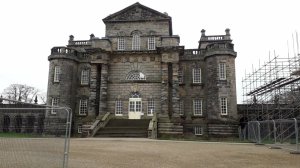
We left for home on a grey, drizzly Friday. En route, we visited Seaton Delaval Hall which is a grade 1 listed country house near Whitley Bay.

The Delaval family were gifted the land when they arrived with William the Conqueror at the time of the Norman conquest. It passed through the family for many generations with varying degrees of success and failure, wealth and bankruptcy. The family’s wealth came from glass, coal and iron.

In 1728, a fairly modest house was replaced by the existing building which was designed by Sir John Vanbrugh. Unfortunately in 1822 while the family were staying at their other house in Norfolk, the central wing was gutted by a fire which was said to have been caused by birds nesting in the chimneys. The fire spread from the south east wing through to the main central wing, which housed the family’s accommodation. Repairs were attempted at various times but the central wing remains as an empty shell with just the roof replaced. However, even with its fire-blackened walls, damaged statues and lack of ceilings, it is still a magnificent building. In later years, the west wing, which had previously been the servants’ quarters, was used by members of the Delaval family as their family home.

Along the way, one member of the family (John Hussey Delaval 1728-1808) was granted a baronetcy. Due to the rules of primogeniture, the baronetcy and the family seat were eventually inherited by a branch of the family whose name was Astley. (I heard today of a move to stop this outdated (was it ever fair?) rule throughout the aristocracy, as the royals had already abandoned it before any of the Cambridge children were born).

During the 20th century some restoration work of the west wing was completed and eventually the 22nd Baron Hastings, Edward Delaval Henry Astley moved there to live and stayed until his death in 2007.

We were shown around the house by some extremely knowledgeable National Trust volunteers. As we were being told about the 22nd Baron Hastings something clicked in the back of my mind: “My husband knew Lord Hastings”, I said. And so he did! When Richard was Social Work Director of the British Epilepsy Association in the 80s and 90s, Lord Hastings was the Association’s President.

I have a letter which I found when going through my photographs, from Lord Hastings to Richard after he left the British Epilepsy Association.

Lord Hastings said: “You have done a splendid job and it was fraught with difficulties over a long period, but you stuck to it and saw it through some very traumatic situations. It is understandable that you should feel the need of a change but you will be a great loss nevertheless and I’m sure that you will be very much missed by everyone. I wish you the best of luck in your new post and send my warm thanks for your services to BEA. Yours sincerely Hastings”.

The 23rd Baron Hastings, wishing to preserve the future of the Hall and encourage greater public access, entered into discussions with the National Trust and it came into the possession of the Trust in 2009. The buildings have been open to visitors since 2010 and major work is now underway, which is being funded by the Lottery Heritage Fund. The aim is to preserve the fire damaged parts of the building as they stand and to renovate the west wing. In addition, huge works are being carried out right across the grounds in the hope of making this a family friendly destination in years to come.
The Cuthbert connection

It’s coming to something when the only piece of post I have today is from a company trying to sell me hearing aids, with some free batteries to tempt me! Still, the trees where I walk every day with the dog are beginning to bud, as are the shrubs in my garden. I have a single miniature daffodil too!

I was surprised to see just how many buds and flowers there were in Northumberland when I went to stay last week. (You see I do have an exciting life sometimes). There were lambs in the fields too. The main pleasure of this time away was being with friends, some of whom I’ve known for over 60 years. I enjoy the company so much and one of my friends is very good at arranging small trips for us. All of us used to enjoy walking and the first time we got together we walked a section of Hadrian’s wall. Now though, most of us enjoy a short walk and leave the couple who are still very active to stride off without us.

The week was so interesting that I thought I would tell you a little about it before going off to talk about my travels further afield.

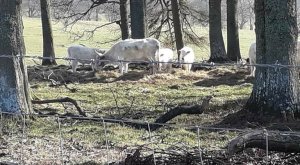
Our first surprise was a visit to the Chillingham wild cattle. This is a small herd of about 120 white cattle, which live in a park next to Chillingham castle. Their exact history is unclear and varies according to who is telling it but it is generally accepted that they have had a pure undiluted gene pool for at least several hundred years. They’re not husbanded except to give them a little extra feed in the winter and are not visited by vets. Nevertheless, the herd continues to grow!

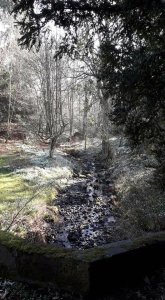
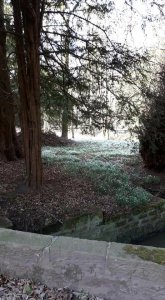
The ground cover isn’t snow – it’s snowdrops!

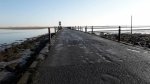
We stayed at the Lindisfarne Inn, which is only a mile or so away from the causeway to Holy Island. Last time we were here, we walked the causeway but this time we were happy to be driven!

The causeway, just as the tide is receding

I was interested in finding out more about St Cuthbert, because my father was named after him. He was an Anglo-Saxon born in 635AD to parents who were Christian converts. He entered Melrose monastery at the age of 16 and was eventually appointed Prior of Lindisfarne (Holy Island). At the age of 41, he decided to become a hermit and left to live on one of the Farne Islands but was persuaded to return to Lindisfarne. But after only two years he resigned and returned to his life as a hermit where he died in 687AD. The monks brought him back to Lindisfarne and buried him.

However, that is not the end of the story. Around 200 years later, the monks evacuated Holy Island in the face of Viking invasions and took his his coffin wherever they went until it was eventually laid to rest in, what is now, Durham Cathedral.

So that is St Cuthbert!

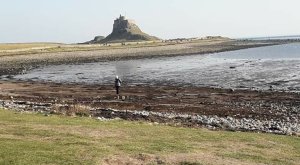
Lindisfarne Castle

I will save the final story until tomorrow….

Where do we go from here?

Well, children. I’ve told you as much as I know (or can remember) about where my family came from, when and where I was born and how I grew up. And, from your point of view, of course, how I met that most important man who became your father.

Do you want me to go further, to talk about the four years we had together before any of you were born? Even the days of your own lives that you don’t remember?

Maybe you want to fill in your own memories. I know you often remember things I have forgotten and vice versa. I need you to let me know.

In the meantime, I’m going to write about my travels.

The REAL summer of love!

I’m still looking through my boxes of photos and yesterday came across some which Richard and I took when we visited Austria to celebrate our 30th wedding anniversary. There is one photo of a bunch of flowers he had bought me and a card with a big heart on it (I’m sure I’ll have the card somewhere).

I’m glad that Valentine’s Day is over for another year. I find it the hardest day to deal with but I loved finding that photo because, together with some Valentine cards I have found, it reminded me of what we once had together.

So, it’s a while ago since I wrote about meeting Richard, in 1968. We had met in early December, spent the evening talking, eating the meal he had prepared (pork chop, mashed potato and peas) and inhaling a lot of cigarette smoke. And he had asked me out again! I can remember waiting outside the Odeon cinema in Bradford thinking “Well it was nice while it lasted”, before he turned up late, as usual. We ended up going to see a film called “Interlude” about a doomed love affair! I don’t remember anything about it but it had a rather melancholy but hopeful song as its theme

“What seems like an Interlude now
Could be the beginning of love”

It became “our song” at least for the time being. (The singer was Timi Yuro). We must then have had a long, earnest and esoteric conversation as I returned home to my little flat a day or two later to find a love letter tucked in my letter box. (I still have it, children).

After that, we grew closer – until university closed for the Christmas holidays and he disappeared with his friend to London and a holiday job in HMV.

Richard was in the second year of a degree in social work. He lived with two other students in a maisonette not far from the city centre. One was his partner in deciding to date every girl at the Central Library. He was not happy when Richard met me, or when my friend dumped him after she discovered he was married. I always felt that he resented me and he tried his best to split us up, even while we were planning our wedding. The other student was barely seen.

Children, you are all well aware of the notorious “Satisfaction Guaranteed” T-shirt, worn under a lacy blue shirt! He used to wear that when he was a DJ in the “Gatto Bianco” night club in Bradford. I was only invited there on a couple of occasions. In fact, I wasn’t included in many of his evening outings with the group of friends (mostly students, I think) who went out drinking most nights all over West Yorkshire. We did once visit a club in the Merrion Centre in Leeds. It was after I had passed my driving test and bought a car. I drove about 5 of us over there. It was absolutely neon! I spent the evening chatting to a lovely man (one of Richard’s non-uni friends) who was persona non grata with his family of local industrialists because he was gay. When we left, I quickly realised that I did not know how to make my way out of Leeds in the dark. I was stationary at a traffic lights, unsure which way to turn, when a police car pulled up beside me. I apologised for not moving promptly away when the lights changed. He said “Don’t you think it would be a good idea to put your lights on miss?” I think that was my only brush with the law in nearly 50 years of driving!

Richard had an eclectic taste in music and, while my favourites had moved on from the Beatles to Joan Baez and Bob Dylan, he introduced me to so much more. He bought me a Nina Simone album for my birthday but I also got to know Captain Beefheart, Janis Joplin, The Beach Boys, Hendrix, Leonard Cohen and many more. Unfortunately, Richard’s and his friends’ taste for partying meant that the university didn’t see them very much. Instead of sitting his end of year exams, Richard stayed awake for several days, causing him to collapse and be admitted to the uni health centre. He emerged determined to make a fresh start and opted to change degrees and begin the second year of a degree in economics and geography when the new year started in October.

Although I loved the independence of having my own flat, I had discovered that being in an old Victorian house meant spending a fortune on heating and, besides, the kitchen was damp. So, in early 1969, my best friend from the library and I decided to apply for a flat in one of the new tower blocks being built near Bradford city centre. The flats were mired in the building scandals of the late 1960s, which resulted in a local architect, John Poulson, being jailed for corruption. Completion was also delayed as a result of the collapse of a 22-storey block of flats in London in 1968. Four people were killed and many injured when a gas explosion tore through Ronan Point, causing load-bearing walls to collapse. Eventually, just the first two floors of our flats were declared safe, while the upper 14 floors were strengthened. (The towers were eventually filled, after several months. When we returned to live in the north in 1986 after our sojourn in Berkshire, we were horrified to see that the flats were already boarded up and were demolished soon after).

By the time the flats were ready in the summer of that year, Richard had already proposed and so, it was really the three of us who moved in. (Children, I have spared you the “too much information” that might outrage your sensitivities but I have to say that your father and I were rather ahead of our time and lived together, albeit in secret – my family certainly weren’t aware!). I still feel guilty that my friend moved out and found somewhere else to live, just a few months later as we began to plan our wedding.

We planned to marry in December but eventually decided that we would bring it forward to October. There was no reason not to! I had no parents to plan for me and Richard’s family lived at the other end of the country so we got on and planned it and paid for it. We planned it small! Richard was a regular patron of a Chinese restaurant in the centre of town, so we decided to hold it there, although we stuck to English food. The cost was 6/- (30p) a head! I wanted to be married at a church in the parish where I grew up, rather than my new parish, so had to pretend that I was still resident at my aunt’s in Bingley. My dress was bought in a sale in a Bingley dress-shop. That was half price and cost 18 guineas (£18 18s or £18.90p). My library friend’s father, who was a baker, made our cake.

The day before the wedding we were rushing around decorating the church, delivering the cake to the restaurant and collecting our outfits. It was very fraught and, I think, we were both tempted to call the whole thing off! Still, it went ahead on 4 October 1969. My very tall cousin Alan walked me down the aisle (it’s hard to believe that I used to be scared of him when I was a tiny girl and he was just a teenager). My library friend and an old schoolfriend were bridesmaids and Richard’s brother was best man.

We had already planned for a honeymoon in France at Christmas, visiting my friends, so we went to London for a long weekend. We left on an early evening train (no such thing as evening “do’s”). The weather, which had been beautiful on the day, continued warm over the weekend and we wandered around parks and shops, we ate at a Russian restaurant and we went to hear Jose Feliciano.

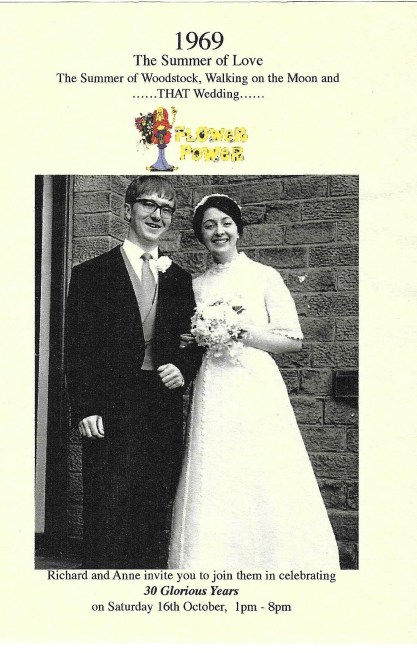
And that, children, was the real summer of love, as claimed on the invitation to our 30th wedding anniversary party…………….

Wedding.jpg

We do like to be beside the seaside!

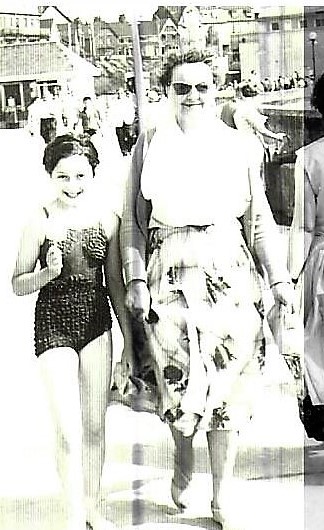
The seaside photo thing in the 50s and 60s was being “snapped” while you walked along the sea front. Later in the day you had to hang around a kiosk waiting for your photos to appear. What are all those “snappers” doing now?

anne growing up 5

The summer after my father died, Mum and I were invited to join her two sisters and their husbands on holiday in Bridlington. Here we are strolling along the promenade, looking about as summery as it gets in Bridlington. We are, left to right, Auntie Violet and her husband, (Uncle Eddie), then Uncle Willie Waite and his wife, Mum’s other sister (Bessie), then me and Mum. We stayed in a B&B, when it was strictly that! You left after breakfast and did not come home until time for the evening meal – tea as it was (and still is) called in the north and bed!

Our holidays always got off to a slow start, as we arrived on Saturday but, for some reason, we didn’t go onto the beach on Sundays, so it was always Monday before the real holiday started. And, of course, that was usually the day that it rained, although it must have turned sunny at some point!

anne growing up 4.jpg

The good thing about this particular holiday is that Mum was wrapped up in the kindness of her family. Someone must also have had a box Brownie with them because I have this lovely photo of Mum and her two sisters.

anne growing up 6.jpg

More family outings

Here is the family Falkingham enjoying more days out.

Anne Baby 6

Anne Baby 9

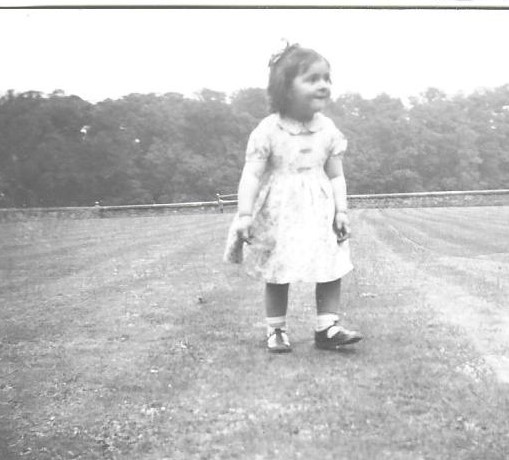
The two photos above were taken in September 1949 at Sir James Hill’s gardens in Apperley Bridge. Sir James Hill was a local businessman, who was also Lord Mayor of Bradford and, latterly, MP for Bradford Central. He was made a baronet in 1917 and a freeman of the City of Bradford in 1921. A busy man! He must have lived in Apperley Bridge (a small suburb of Bradford) at some point.

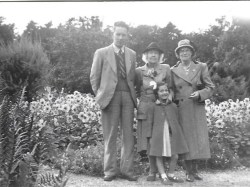
The photo below was taken in August 1952. Here I am, aged 5½, with Dad, his older half-sister Doris and, in the centre, their mother Ethel. We were visiting Warter Priory, which was situated in the Yorkshire Wolds. The house was built in the late 17th or early 18th century. Major extensions occurred during the Victorian-era and further alterations in the early 20th century, resulted in a house with nearly 100 rooms! Sadly, the house and gardens were demolished at the beginning of the 1970s. On a sartorial note, Grandma always looked smart but I don’t remember seeing Auntie Dodo (Doris) in a hat very often (although she did wear one to my wedding). I’m pleased to see that the Plus4s remained in the wardrobe but the tie should really have been tucked inside the jumper Dad!

Anne Baby 5.jpg

Brearton is a village near Harrogate in North Yorkshire. From time to time we visited stables there and Dad and I would ride out on two horses. Mine was called “Candy” and was a small, steady pony, except on the occasion when she ran away with me down a field! I loved it and it was my dream to do it more often. Unfortunately, I had to be content with riding imaginary horses through the Bingley woods while pretending to be a cowboy! These photos are dated 1953.

Anne Growing up 2.jpg

Anne Growing up 1.jpg

Family outings in Yorkshire, 1948

Mum and Dad and the rest of the family were often photographed visiting gardens, stately homes or the local countryside. It’s not surprising as Dad worked long days in the shop and stayed open five and a half days a week. And they obviously didn’t stop after I came along.

Anne Baby 1.jpg

Anne Baby 7.jpg

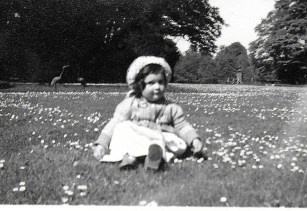
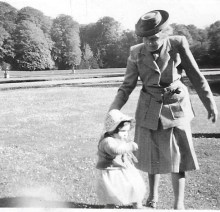
I’ve found Grandma’s spidery writing on some of the photos but not these two. I feel sure that we will have been visiting a country house somewhere in Yorkshire and I’m guessing that it could have been spring 1948. People have always told me that I’m like my Mum but perhaps that was when I got older, as I think I’m definitely a Falkingham here.

Anne Baby 4.jpg

Anne Baby 8.jpg

These two were taken at Gilling Castle, Ryedale, North Yorkshire in August 1948. Gilling Castle is a Grade 1 listed building, with origins in the late 14th Century. I have very few photos with both my parents and it warms my heart to see how happy they look here. They waited a long time for me, having first met when Dad was 17 and Mum 19. They didn’t marry until they were 32 and 34 respectively and here they would have both been in their early 40s. I’m relieved to see that Dad isn’t wearing his Plus 4s! What appears to be a spot in the middle of his chest could well be his watch chain. He almost always wore a waistcoat and carried a pocket watch with a hunter case and a chain.

“To Mr & Mrs C Falkingham (Manningham) a daughter ….

…. Both well”. You can’t accuse my parents of overdoing the announcement of my arrival on this day in 1947 (in the Telegraph and Argus). I was brought home, after my mother had taken the statutory two weeks of bed rest, to our shop in Manningham.

Falkingham shop 2.jpg

Falkingham shop 1.jpg

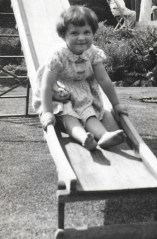
Thankfully there are no tiny baby photographs. In those days, there was a dreadful practise of photographing new babies, lying naked on a blanket! The first photograph I can find was taken at 8 months, when I am already showing my independence and supporting myself (unless that is an arm partly hidden behing my back).

Anne Baby 2.jpg

72 years later, I’m celebrating with my family. Sarah, Louise and your own families. We were talking via video WhatsApp to Jonny in London. I wonder what my parents would think of that?

I’m also celebrating the fact that I have just been pronounced cancer free one year after spending my previous birthday in hospital having a kidney removed.

Now, if only this bloody Brexit would go away, I would be able to get on with the rest of my life!

Two weddings, a dumping and a new beginning

I picked myself up at the start of 1968, thanks to family and friends. I was working in the Children’s Library and one thing we were doing was helping to welcome the families who were beginning to follow the men who came to Bradford from Pakistan to work in the mills and on the buses. At that time, children who were newly arrived spent some time in separate schools learning English, a very different approach to nowadays when children go straight into mainstream school and simply assimilate the language. Anyway, we used to visit these centres regularly, bringing books with us, as well as entertaining children from all over the locality at our regular storytimes and craft sessions.

In July, I went to France again to attend Françoise and Claude’s wedding. What an experience that was! I met her in Troyes, I think. Françoise was just about to begin her teaching career and I stayed with her, in the school where she worked as a monitor until the it was the end of term. Then we drove home to the help with preparations. They day that I went with the two of them to purchase some of the alcohol for the celebrations, I keeled over asleep in the car on the way home! The day before the wedding a chef arrived (and stayed for 3 days) and dinner was prepared and served to a large number of guests in one of the buildings outside the house, which had been decorated specially for the occasion.

Next morning I dressed in a brand new outfit. Françoise told me to ditch the hat as no-one wore them any more! I was rather disappointed. Guests gathered and we walked in procession through the village with Françoise and her father at the front, then the bridesmaids, all the guests and Claude with his mother bringing up the rear. The first part of the service was at the Mairie (Town Hall), a civil service performed by the mayor. Then we all processed to church (which we had cleaned ourselves) for the religious ceremony. Almost immediately after this was finished, the bride and groom disappeared for at least an hour – they had gone to a studio for a formal indoor photo. Then back to the village for a single, enormous group photo. I was perched on a bench high above them on the back row, with my “companion”. He was chosen to accompany me as one of the very few unattached young men. He was not my cup of tea. I can’t explain why but he wasn’t!

The wedding meal was several courses long and lasted for several hours. There was a fabulous croque en bouche, the “pièce montée” at the end of the meal, lots of wine and champagne was consumed, then we danced in the village hall until it was time to eat and drink all over again in the late evening. More dancing followed and the newlyweds disappeared. Then, all of a sudden, everyone was piling into cars and setting off to find them. They were “hiding” at Claude’s parents’ house, the bedroom was stormed and we all drank champagne from a chamber pot! I arrived back at the house at 6am to find that everyone else had retired to bed, including a couple who were asleep in my bed! I staggered down the road with Françoise’ cousin and was found a bed at a neighbour’s house. There was another enormous lunch the next day to finish off the celebration and then I returned home.

I then took the huge step of moving into my own flat. I was feeling uncomfortable at home. I wanted to be able to do spontaneous things with my friends but I was expected to return straight home from work every night. Auntie was of the opinion that “nice girls” had no reason stay out after 10pm. Perhaps I just needed some independence. I found a flat in Bradford, went along to see it with an older cousin and plucked up the courage to tell Auntie. She was furious. She thought that she would never see me again. I promised her that that would not be the case and 24 hours later she relented and then gave me a number of lovely and useful items which set me up in my new home. I had a groundfloor flat at the back of an enormous victorian villa on the outskirts of Bradford’s city centre. It was not far from where I had lived as a child. In fact, only the red light district divided us! I quickly moved in. The rent was £16 per month.

It was around this time that I was unceremoniously dumped by my boyfriend of just a few months. We were introduced by a mutual friend at work and over the course of the summer months he would pick me up in his car and we would go for a drive and usually listen to “Beyond Our Ken” or “I’m sorry I’ll read that again”. We didn’t meet up at work at lunchtime; I suppose we only saw each other once or twice a week. I remember we did go to see “Bonnie and Clyde” when it first came out and to one or two parties but it remained fairly low key. The end came when I invited him to my new flat and fed him the latest thing in instant catering – a Vesta Curry. As most of us had never tasted a real curry at this time, we thought this range, which you made from a dessicated state by boiling it in water, was the real deal. It definitely was not! You had to be there to appreciate just how dire this stuff was. Anyway, as he left, he said “I don’t think we should see each other any more”. I said “Oh, alright” and we parted company. I didn’t ask why.

So then I was bridesmaid for the other friend who had come with Françoise and I to Scotland. It was a lovely day and Auntie came too. Which just reminds me that I had already been a bridesmaid for another friend who was married in late 1966. I was surrounded by weddings and still no-one in sight for me!

I applied for the post of the Children’s Librarian of Halifax. I had flourished under the mentorship of Vera Jacques, the innovative Children’s Librarian of Bradford. My library qualification was going well, if slowly. It was a day-release course paid for by my employer and took around 5 years to complete. I was successful and started in the autum of 1968. I also made my final appearance with Bingley Amateurs in the chorus of “Die Fledermaus” (The Bat) a Strauss operetta.

The end of the year was approaching and I was rehearsing with colleagues from my previous job ready to sing at the Christmas party. The friend who had introduced me to my previous boyfriend now invited me to go on a double date with her. She had met a group of students from the university (not sure how). She and another friend had gone out with them but it hadn’t worked out for the other couple. My singing friends gave me a lift to the flat where these students – 3 of them from Bradford University.

Children! I was about meet your father. He came down the stairs and I thought “I always end up with the short, round one”. For some reason, the three of them all lived in their own rooms and there was no socialising in the living room. I sat in his room while he prepared a meal of pork chop, peas and mashed potato. We talked for hours until I insisted on being taken home. His friend, a young man from Iran, had a Ford Capri! Richard asked to see me again…..

And to quote Charlotte Brontë “Reader, I married him”!

The girl who missed the summer of love

They say that, if you remember the 1960s, you couldn’t have been there! I was so conventional and unadventurous that I do remember all of it. The “Summer of Love” in 1967, however, completely passed me by, although for me it happened in 1969 instead.

For those who were there but don’t remember, as well as those who were not yet born, the summer of 1967 saw a great gathering, a “love-in” of hippies in San Francisco.

“If you’re going to San Francisco
Be sure to wear some flowers in your hair
If you’re going to San Francisco
You’re gonna meet some gentle people there”
(John Edmund, Andrew Phillips)

If you’re unsure what a hippy is, I suggest you visit Wikipedia, as I’m not going to explain here. You could also listen on YouTube to Scott McKenzie singing this anthem for 1967.

Me? Well I was going on holiday with Françoise, back for her second visit and newly-engaged and a former schoolfriend, just back from teacher training and also newly-engaged. The three of us were off to Scotland, back to Oban which I had last visited at the age of about 4. We stayed in a small hotel, learned to eat porridge with salt instead of syrup, tried haggis, neeps and tatties and had fun exploring the locality. We did not visit any pubs because, at that time, Scottish pubs did not welcome women!  Our big trip was a repeat of my visit by boat to the island of Iona.  We had an interesting time – until we boarded the boat back to Oban.  It became very rough and Françoise began to feel very sea-sick.  She disappeared below deck and could not be persuaded to come out into the fresh air.  Afterwards, when we were back on dry land and she had recovered, we laughed a lot. It was a good holiday.

While I was in France the previous year, Mum went on holiday to Hastings with my Auntie Elsie and they flew to Le Touquet for the day.  This trip to France was the first time she had left England and she had greatly enjoyed it.  They planned to have another holiday in 1967 but then, early in the summer, there was a query when she went for her annual breast-cancer check up.  The consultant asked if she always had a croaky voice.  It wasn’t something that we had really noticed but it was the sign that a secondary cancer had developed and, when she was due to go away on holiday, she was, instead, admitted to hospital to have fluid drained from her lungs.  As the year went on, her health declined very rapidly.  I have a photograph of the two of us at my cousin’s wedding in October, which I find very hard to look at but which I can’t bring myself to throw away. It’s our last photo together.

In November I returned to the stage with Bingley Amateurs, this time in the chorus of “Summer Song”, based on Dvorak’s “New World Symphony”.  On the penultimate night I fell while leaving the stage and was carried off to hospital in full make-up and costume, where it was discovered that I had torn a ligament in my ankle.  I couldn’t go to work for a couple of weeks and, with hindsight, I am so grateful that I was able to spend this time with Mum.  When I visited our GP about returning to work, I was shocked when he warned me that she was soon going to die.  I think that, deep down, I knew it but I wasn’t able to admit it to myself. She slipped away day by day and then, one evening a few days before Christmas, she died.

A wonderful family and group of friends gathered around and I had a very understanding boss.  I can still remember making all the arrangements for her funeral, going to see her and thinking that all the suffering had gone from her face.

The same family and friends helped me to celebrate my 21st birthday in Janury with a small dinner party at home.  1968 was a bit of a roller coaster but it did have a happy ending!