
In search of T27 – The Dhawajandi Female – Part 2
(or it might have been T31 Chhoti Mada Female)
India 2017
It’s hard to explain the feelings of excitement and anticipation as the gates open and you drive through into the Park. At first the jeeps drive in line until they reach the point where they separate to visit the different zones of the park. From our entry point at the Mukki Gate, we could visit the Mukki Zone, the Kanha Zone and the Kisli Zone. Each of these have different habitat and different inhabitants.
There is little to see at first, until the jeeps have split to go off into “their” zone. Then you are going to marvel at the sight of so many animals and birds, which you have never seen before. I believe that, in 2017, there were around 20 Bengal tigers with territories within the Mukki Zone. Of course, there is no guarantee that you will see a tiger, although that is what you hope for and on the morning of my last day at Kanha, of course I had tigers on my mind. My wish to see these beautiful creatures in the wild was what had brought me on my first visit to India. However, I kept reminding myself that I should just be amazed that, at the age of 70, I was really here, bouncing along in a jeep in a forest in the heart of India. On that first visit to Kanha, most days I went on two drives. I saw several species of deer and antelope, including rare Barasingha (or Swamp Deer). Kanha is home to the only population of the sub-species of Southern Swamp Deer. As their name suggests, they like to spend their time grazing, often up to their bellies in water. I saw other rare species, including sloth bears and wild dogs and, thanks to the naturalists who were able to point them out far in the distance, so many birds whose names I had never heard of, many species of owls and eagles and, of course, the more familiar peacock. In fact, I had so many wonderful experiences in Kanha that I am sure I will write about more of them another day and I still hope to return there some time.
Back to that morning….
We had not been in the park for long, although the sun had come up and it was starting to warm up a little, when we were called over by another jeep, who had seen and heard signs of a tiger nearby. It happens regularly – there will be an alarm call, perhaps from a group of langurs, which is heard by the naturalists and so jeeps will head towards it and wait to see what appears. It may be nothing. You can wait and wait and no tiger will appear, or the alarm calls will move away from where you are waiting. You may even catch a tantalizing glimpse of an orange stripe and then it just disappears.
On this occasion, the other jeep soon left but we stayed on and we were eventually rewarded when a female tiger appeared from the forest and walked straight onto the path in front of us. She sat down for some time and then stood up and began to walk towards the jeep as we just sat there silently, totally mesmerised. We had been warned to stay seated, remain quiet and not lean out of the jeep in order to take photographs. Then, we were told, the tiger would simply be aware of a single large “mass”, which she would ignore. And so she did.

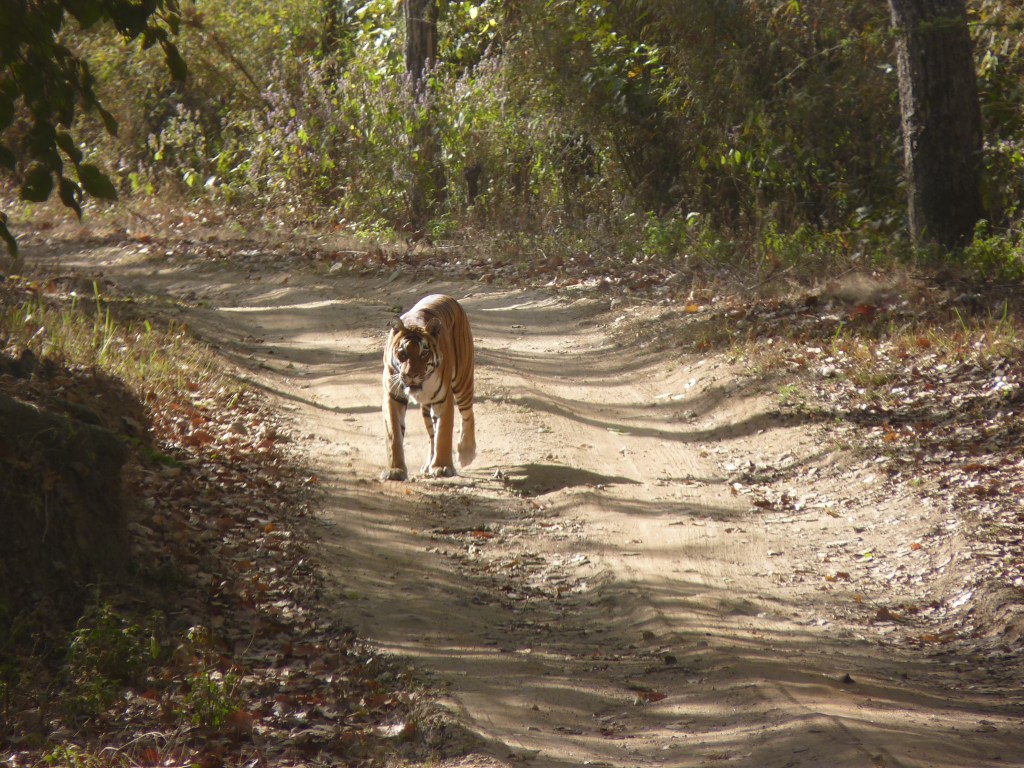

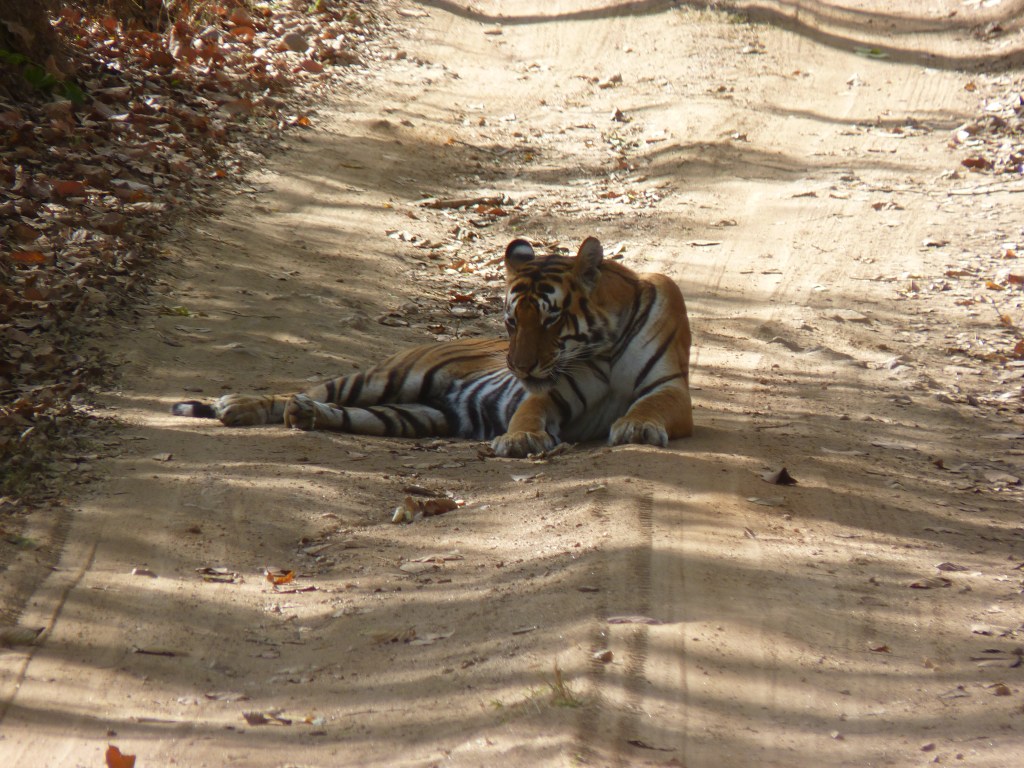
Our naturalist reversed slowly up the path towards a junction where he waited as she walked straight past us without a glance.
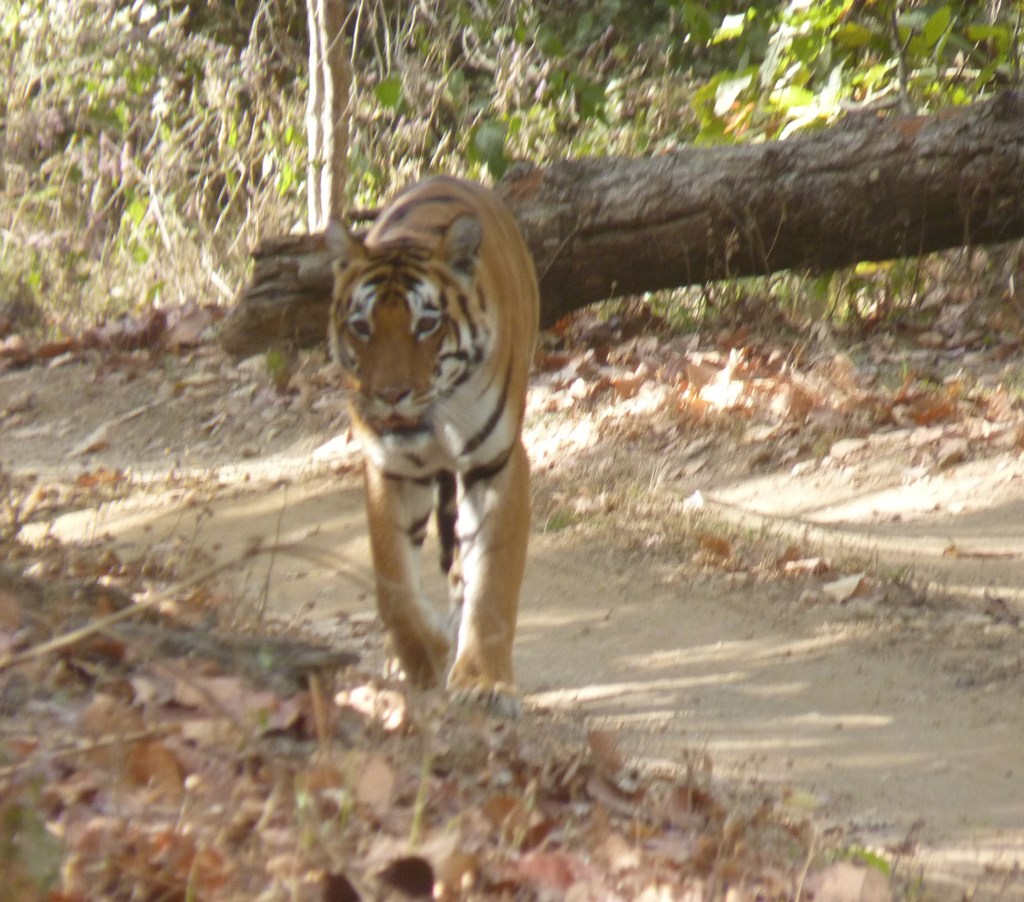
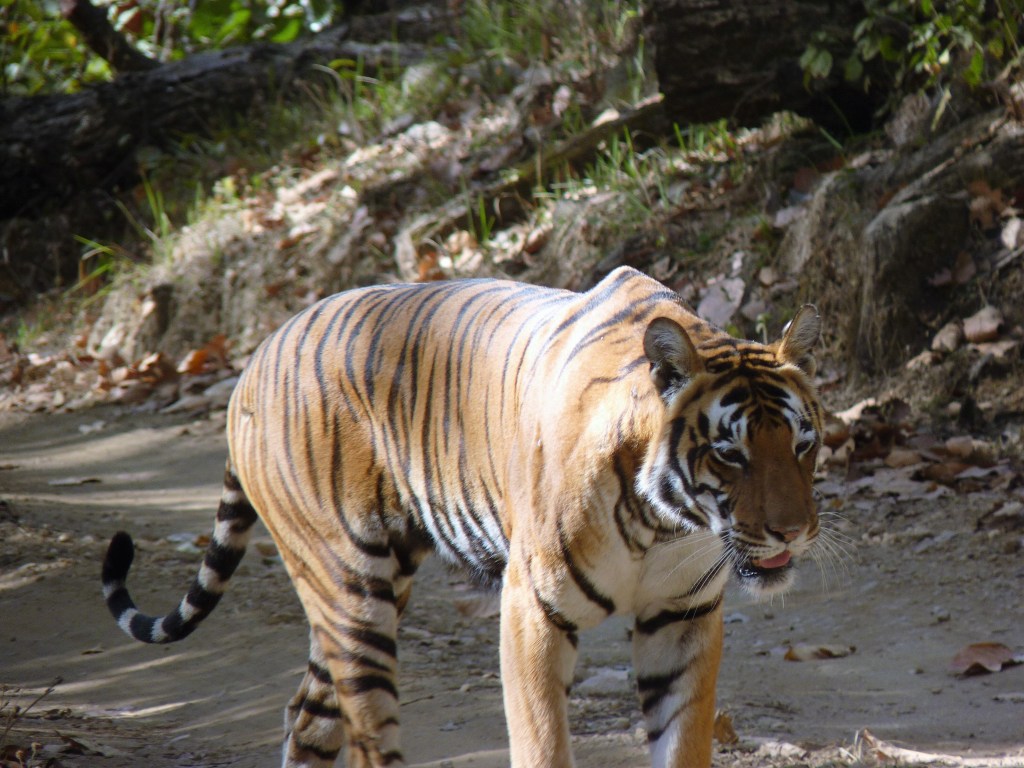
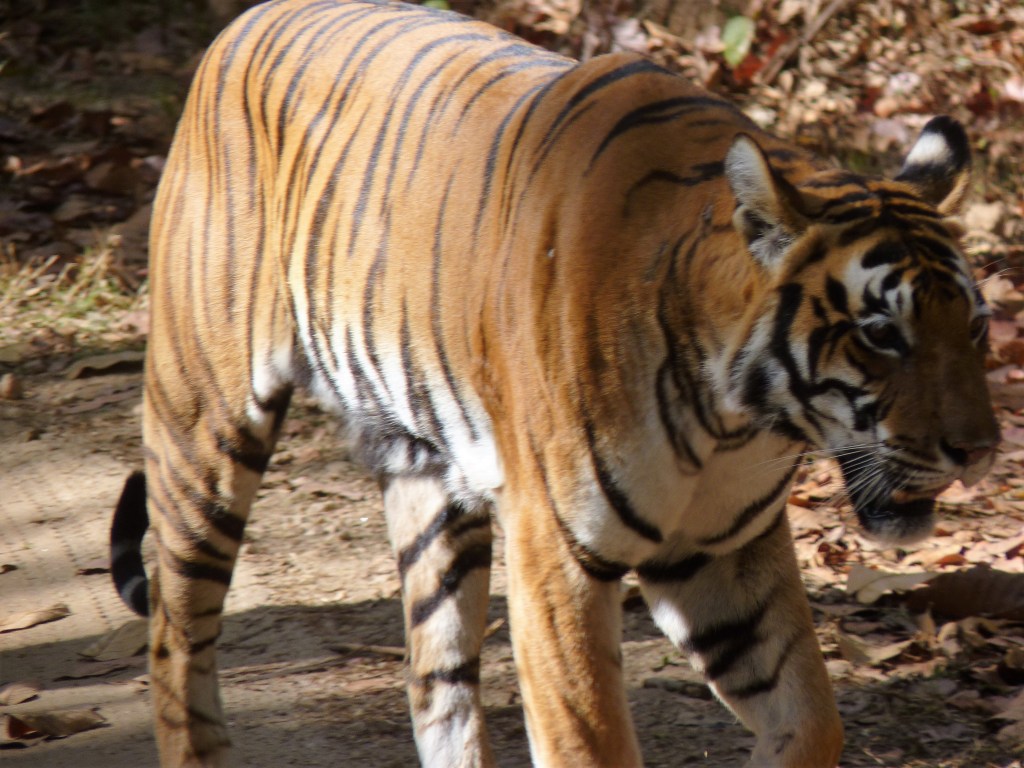
We were able to follow her as she paused occasionally to scent mark. Suddenly she stopped and crouched down, as if she was starting to hunt. There was a spotted deer ahead of us and she had seen it! She crawled through the grass on her belly, finally hiding behind a tree just yards away from the deer. We stopped and turned off the engine. We could hardly breathe. Then the deer saw her and ran. To be honest, I was relieved! The hunt was exciting but I’m not sure I wanted to share in one which ended with a success for the tiger rather than the deer.
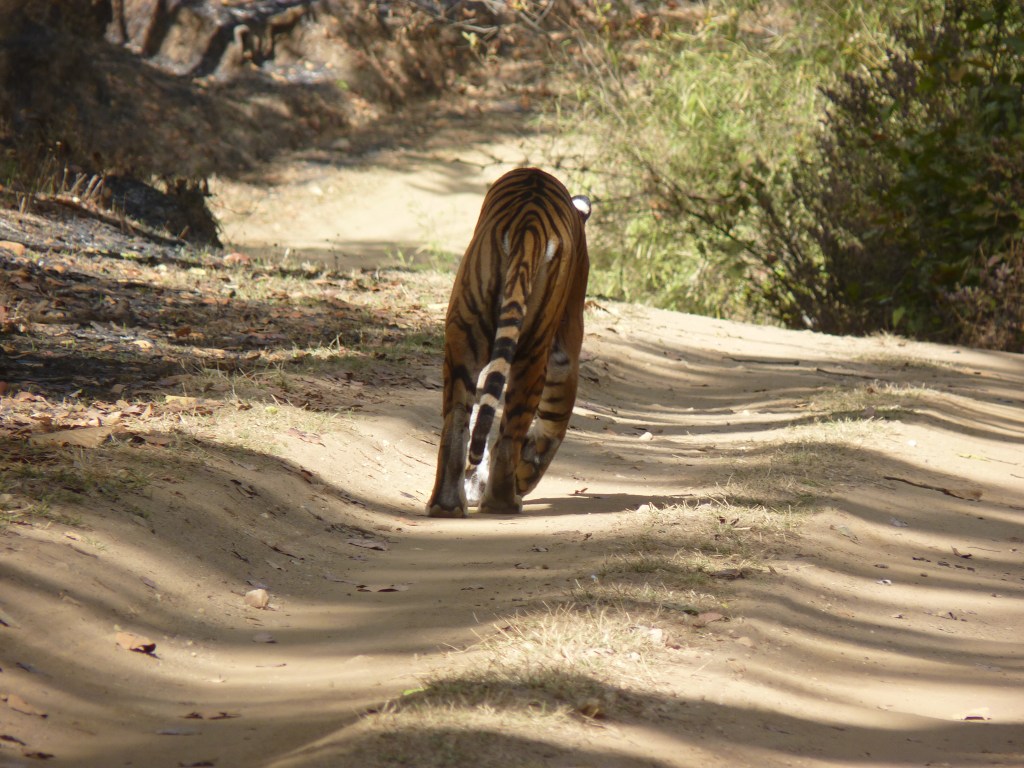


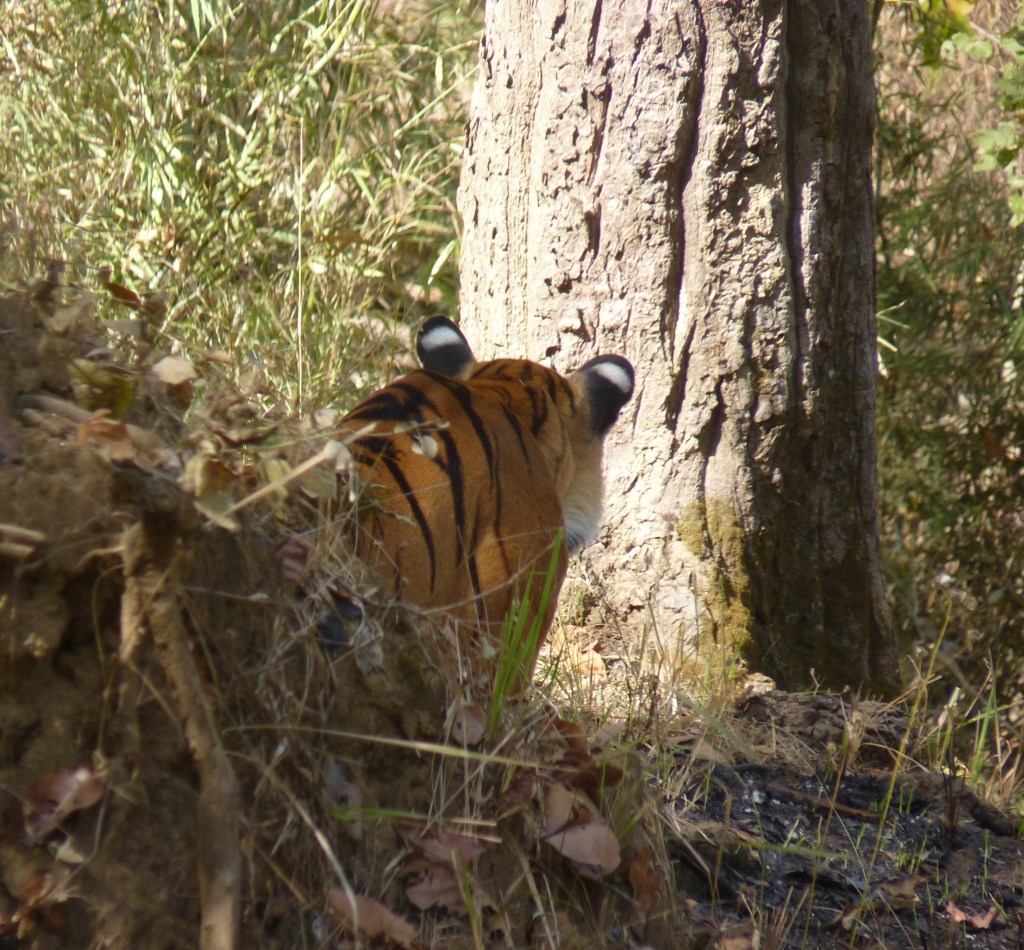

The tiger wandered back across the path and, in a second, disappeared into the forest. Afterwards, we couldn’t stop talking about her; her size as she walked towards us, the fact that we could see the individual hairs of her coat as she walked alongside us, that hunt and how it ended and just our luck to have spent almost half an hour in the company of such a magnificent animal. The conversation carried on at our breakfast stop. By the time we returned to camp, it was late morning and the day had heated up so that I had peeled off my excess layers of clothing. We were met with cool flannels to wipe our hands and face and even cooler drinks and, of course, we couldn’t wait to tell everyone else about our exciting morning! That early morning start was vindicated!
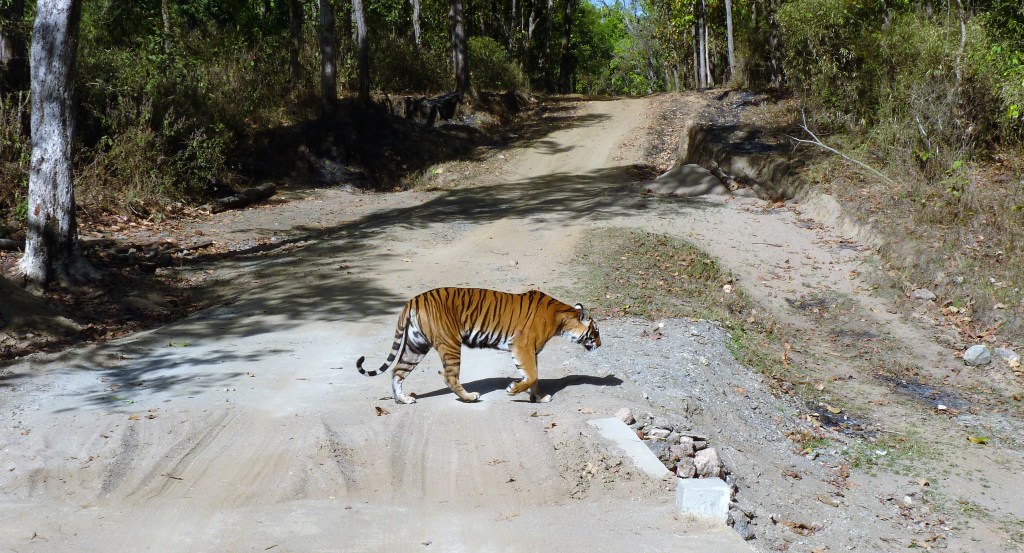
I have a book called “Tigers of Kanha”, complete with photographs of all the known tigers living in the park. They each have an identifier and I believe that this tiger was either T27, also known as Dawajhandi Female or, more likely, T31, also known as the Chhoti Mada Female. I have been looking at two editions of the book and, while I know that T27 had a litter of four cubs, they were not born until mid-2017. On the other hand, T31 had two cubs born in 2016, of whom only one survived. From my diary, I can see that we had briefly seen “our” tiger the day before, accompanied by a single cub (although she was alone on the second occasion) so I think that might be her.
After lunch, we left for our second drive full of hope that the morning’s tiger sighting might be repeated, but although the drive was filled with all sorts of life and totally engaging, the tigers all remained elusive. The next day, I bid farewell to Kanha National Park and Shergarh Tented Camp and set off, first by car the 77 miles to Jabalpur, then 110 miles by train to Pipariya (with delays this took a massive 3 hours!) and finally an hour to drive the last 22 miles to Reni Pani Jungle Lodge for the second part of my adventure in Satpura National Park.
 One Anne and Her Dog