Yes….. I am here on my own

A very special visit – Borneo 2005

I have always had a list of animals that I really wanted to see for myself, in their own habitat.  Since this trip in 2005, I am pleased to say that I have seen quite a lot of them, although there are still a few that I haven’t seen.  I have always had a special place in my heart for Orang-Utans, as usual it’s down to the wonderful David Attenborough and his TV series’ stretching back almost 70 years to the days of Zoo Quest.  I had never thought I would get to see them living free lives in the jungle but, after the success of my trip to New England in 2004, I decided to let my ambitions run wild and decided that my next holiday should be in Borneo.

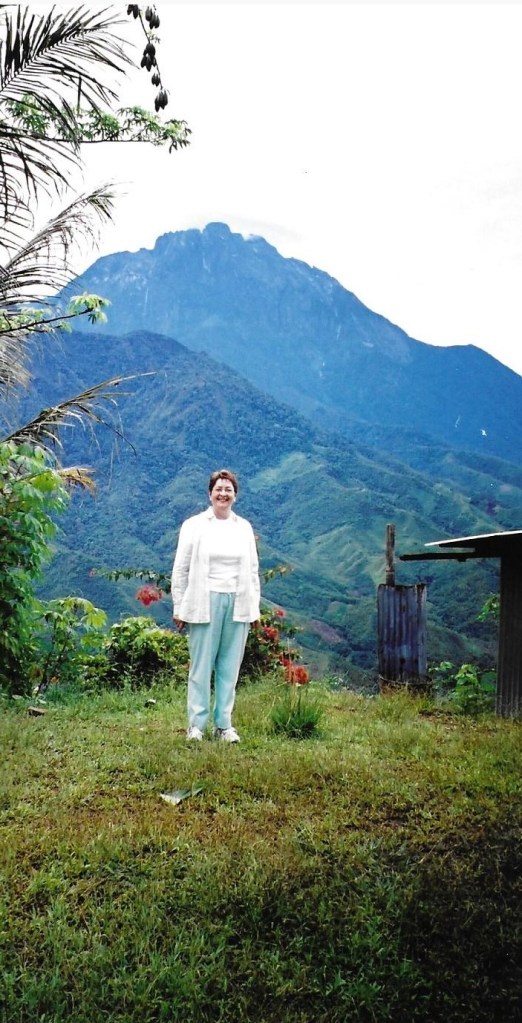
I arrived in Malaysian Borneo a few days before the “very special visit”, via Dubai airport and Bandar Seri Begawan (the capital of Brunei) airport and in the safe hands of Saga Travel.  I had had a tour of the capital, Kota Kinabalu, including the main mosque, a Chinese temple and the city museum.  I had thrown some pottery, visited a batik factory and explored the lower slopes of Mount Kinabalu, where I saw a huge variety of plants, including many species of orchid.  Some were similar to the orchids we see at home, some were so tiny you could hardly see them and one (and it was visible only from behind tall railings) was worth, so we were told, $10,000. 

I had settled in to an enormous room, which had a large patio with a view of a small stream from which, one day, an large monitor lizard emerged and looked me straight in the eye.  I had also done battle with a cockroach which refused to succumb to being sprayed by deodorant or hairspray but finally fell to my blows with a waste bin.  I had been so horrified that I couldn’t bring myself to pick up the remains and left it in my bathroom while I went for dinner.  Imagine my horror when I returned, to see that it had disappeared.  Had something else even bigger come along to devour it? It was a while before I calmed down and realized that my bed had been turned down and that the person who had done that must have been brave enough to do what I daren’t.  Looking back at my diary, I also seemed to have consumed a very wide range of coctails, with ridiculous names. 

Finally, although everyone had been very friendly when we were out and about, no-one had invited me to join them for dinner at the hotel.  I had learned the year before to be prepared for this and had a supply of books with me so that I would not feel uncomfortable and they came in very useful when I dined alone. This was only my second solo trip and it was, in fact, the last time that I didn’t share all my meals with fellow travellers. I think I got more confident and found it easier to ask “Do you mind if I join you?” It works! People are on holiday are kind, by and large so, if you find would prefer not to dine alone, give it a try.

Anyway, back to the visit…..

On the day of the trip I was up at 4am, ready for my flight to Sandakan.

In the Plane
What a relief! I’d been expecting a tiny plane, which worried me a bit but here I was, sitting in the middle of a half empty cabin of at least a hundred seats. I was on the 7:00am flight from Kota Kinabalu to Sandakan, hoping to fulfill one of my long-held dreams. Around me there was a rustling of paper and foil and a pleasant spicy smell started to emerge as some of the other passengers unpacked their breakfast, and I was rather envious. Of course, a forty-five-minute flight doesn’t come with a meal, just a tiny packet of nuts, so the smell reminded me that I had already eaten most of my breakfast, provided by the hotel, while I was still sitting in the airport at silly o’clock. That is, except for the hard-boiled egg! Why does every hotel, wherever it is in the world, think that a hard-boiled egg is a mandatory component of a packed breakfast or lunch? Mine had gone in the bin, so I was beginning to feel peckish!

The other passengers appeared to be people travelling for work or travelling home, perhaps after a shopping trip to the capital, judging by the bulging bags and parcels they carried with them onto the plane. And, of course, the passengers included my companions for the day, a couple who were staying at the same hotel as me and our guide.

In this half-empty plane, I had taken a window seat. We were flying over some of the densest jungle in the world and I had to see it. The trees couldn’t all have been the same  height, but the canopy looked flat from the plane, like countless heads of broccoli. It undulated up and down hills, a luscious dark green. Then it happened. Of course, I had read about this, I had seen the TV programmes, but it still came as a shock when, suddenly, the trees stopped and were replaced by bare, brown earth. Bare, brown earth punctuated by rows and rows of stubby palm oil plants. And so it went on, mile after mile until we reached Sandakan. There were odd glimpses of forest here and there and I was able to see how different the trees were. Some must have been more than 100ft tall, while others nestled below them, perhaps stunted by the lack of sunlight. This awful destruction was the reason I had come on this holiday and taken the flight.

In the Classroom
Along with my companions from Kinabalu and a local guide, I had arrived at the Sepilok Visitor Centre, where we were shown past the inevitable (if small) gift shop to a room rather like a classroom.

We joined a number of people who must have been waiting for us to arrive.  It was extremely hot and the noisy ceiling fans did little to cool it down.  Around the walls were photographs of some of Sepilok’s residents past and present. We were not allowed to visit the little ones who lived on the premises in case we brought them our germs, and this was why we were sitting in this room waiting to hear about them instead.

We heard the terrible details of how many of the babies were found, often clinging to their  dead mothers and barely alive themselves. And we heard about the work of the rescue centre, its wonderful staff who are surrogate mums, and the many satisfying outcomes when orangs were eventually released back into the forest.

Although we had all tried to avoid sitting too close to each other, I was getting pretty hot in this airless room. I’m sure everyone else was too so it came as a relief when it was announced that it was time to go out into the reserve and, hopefully, see what we had come to see – orangutans swinging through the trees.

In the jungle
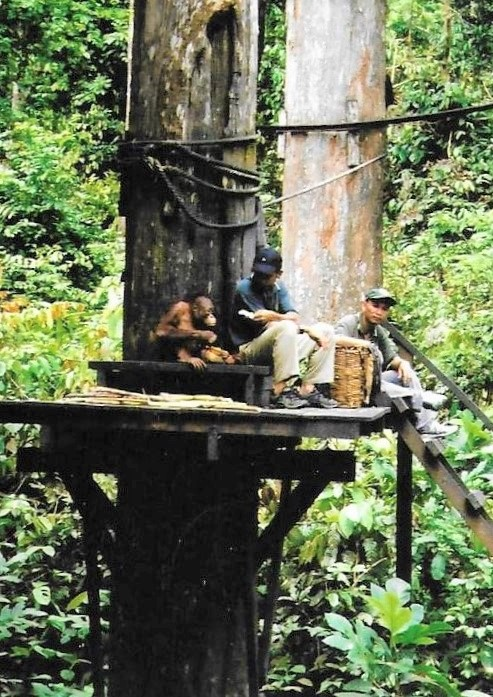
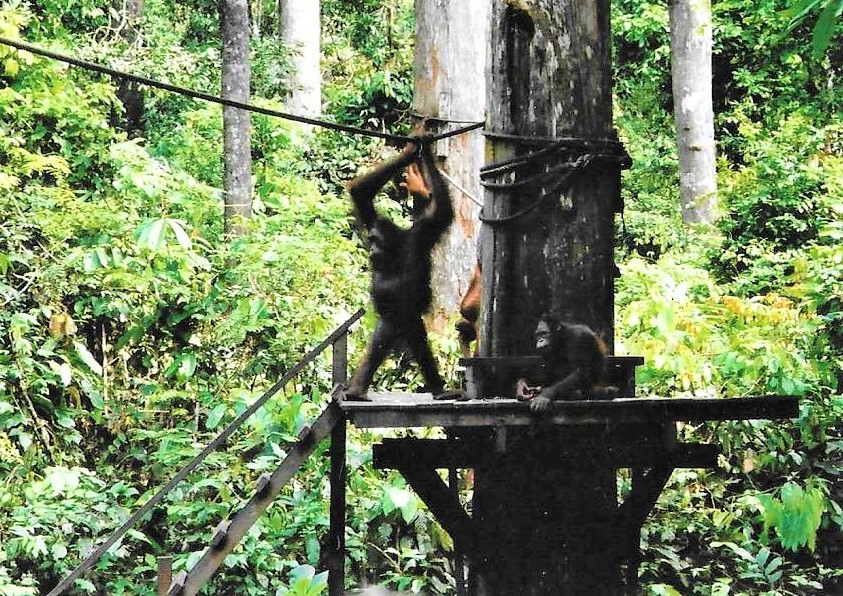
It was even hotter as I stood with my video camera on the edge of Sepilok Forest Reserve. But not the dry heat of the room we had left, it was jungle hot and damp. The forest was no longer the flat canopy that I had seen from the air but trees of different species and heights,  trees with enormous wide trunks stretching up as far as I could see, dark green leaves blocking out the sky; some with shorter, spindly trunks, more like the trees we are used to at home with paler leaves. Many had creepers hanging down or tying them to their neighbours. The smell was of the damp earth, as if it never quite dried up after a downpour. In front of us was a wooden platform built around the base of two trees and on it were two small orangs rolling about it in play like a large red hairy sphere that occasionally broke into two and then re-joined. They must have been aware of the men coming towards them carrying buckets of bananas and long sticks of sugar cane because they broke off from their  play and were soon helping themselves to bananas before the men even had a chance to climb onto the platform.

They kept everyone entertained for a time as the two men ruffled the youngsters’ hair and handed them more bananas and sugar cane but suddenly, a movement caught someone’s eye, there was pointing and there were voices saying “Look. Look over there!”  No-one shouted but everyone seemed to have heard and soon we were all looking towards the distance where we could see trees were bending and waving.

The anticipation was growing. This was something that had not been promised but we had all hoped would happen, after all the orangs are free to roam in the forest and whether they choose to visit the food bonanza is up to them. The shaking amongst the treetops got closer and closer and at last we saw a young orangutan swinging towards us until it joined the little ones on the feeding platform and helped itself to sugar cane. And they kept coming, sometimes announcing their arrival by the vibration of a rope snaking between the trees. If they noticed us, they didn’t care. The bananas and sugar cane were all that mattered. Some ate them on the ground, some ate them swinging upside down and hanging by their feet. Some stayed to play on the platform and others took their bounty and disappeared back into the forest. And finally, a fine maturing male with a long, thick red coat and a broad, flat face with those characteristic flanges on his cheeks, moved slowly towards us between the bowing trees. He paused in front of me and lazily performed some acrobatics in one of the trees before moving towards the platform. All the others, acknowledging his presence, moved out of his way and, totally ignoring them, he swung towards the food. He grabbed two long pieces of sugar cane and, holding them between his toes, he disappeared  back into the forest as quickly as he had arrived.

It seemed the right time for us to disappear too. An hour had passed while we stood there and I was noticing  large wet patches appearing on t-shirts everywhere, including mine and sweat was running down many faces. Our guide suggested that we should move on and, reluctantly, I turned to go. Shortly afterwards and without the slightest hint of irony, the four of us were sitting, eating fish and chips, bread and butter, with a cup of tea at the nearby “English Tea Room and Restaurant” (a relic of pre-independence days) and swapping our new memories.
Yes….I am here on my own

A Fresh Start

New England in the Fall – September 2004

After booking this first solo holiday at the start of the year, I waited, with growing anticipation as the months ticked by, until suddenly, there I was, dropped off at a guest house near Manchester Airport and about to set off on my first big adventure.  Was I more scared than excited or more excited than scared?  I’m not sure, although the fact that I was already awake before my alarm went off at 5:30am might give you a hint.  My host, who hadn’t been too enthusiastic when I had told him what time I needed a lift in the morning did, after all, turn up on time so that, at 7:30am, I was arriving at the airport ready for my flight to New York.

Before going any further, I should explain that I do not have a phenomenal memory, but a holiday diary has always been a feature of the weeks, (even a month on one occasion) that I have spent away.  I try to write something every day, even if the day has been fairly uneventful and certainly when something unusual or amusing happens. Reading them always takes me back and often sparks off other memories. I have a box full of notebooks and envelopes containing tickets, leaflets, brochures of places visited, receipts for meals, information from the holiday company, etc.  However, I have not been so good at keeping track of pre-digital photos, so early holidays are not very well illustrated.

Back to Manchester Airport, where I had some breakfast and then decided that I absolutely must venture into the Duty Free shop. It was a pleasure to look around Duty Free, since there had been so many years when our mainly EU meant no duty free prices for us. I made the obligatory perfume purchase before I hurried to the gates, arriving just in time to learn that there was going to be a half hour delay.  When we finally did get away, the flight was rather bumpy due to the bad weather and we landed, now an hour late, through grey clouds and rain.

There was an enormous queue through immigration and customs, not unusual when visiting the US, I came to learn (and heard from others). When I had successfully, if slowly, passed through immigration, it was another great relief to discover that my luggage had also arrived in one piece at same destination as me. Then, finally, I was out of the arrivals hall and looking for someone holding up a sign that meant they were there to meet me. I headed for the person holding up the name of my tour and was eventually joined by 10 other travellers from the UK.  We were driven down 5th Avenue, through Times Square, past Radio City and the Rockefeller Centre, to the Sheraton on 7th Avenue.  It was late afternoon by the time we had checked in and I decided, quite bravely I thought, that I would head out to have a look around and get something to eat. Much to my relief, I bumped into two others from my party who had decided to do the same and we joined forces. We walked for several blocks and then ventured into “Brennigans Irish Restaurant and Bar”, where we had our first experience of plus-size portions. After consuming chicken strips like girders and a refreshing beer, we left with a shout of “Have a great night!” ringing in our ears.  We walked back via Broadway, had a quick coffee in the hotel foyer and by 8pm my “great night” was well and truly over.  I woke at midnight thinking it must be morning, then again at 3am but eventually I snatched a few more hours’ sleep before obediently leaving my suitcase outside my room, as instructed at 7am.

After breakfast we met our Tour Manager, climbed on the coach and set off down Madison Avenue, past Central Park, through the Bronx and on to Interstate Highway 95, heading for Newport, Rhode Island.  Truth be told, I was pleased to be heading out of the city and towards the autumn colours of New England. 

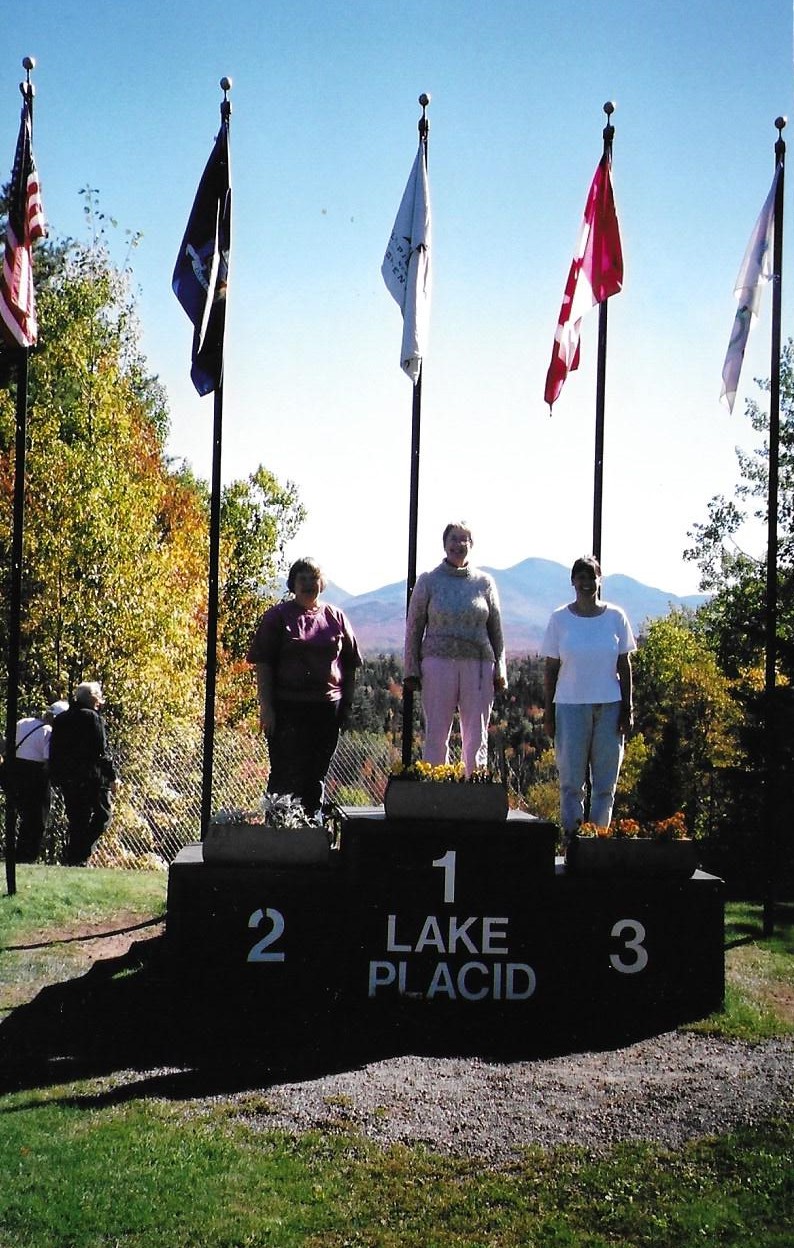
I loved this holiday, mostly driving through the countryside and seeing the trees changing their colour as the time went on.  I particularly enjoyed a (very cold) whale watching expedition off Bar Harbor and standing at the top of the ski jump at Lake Placid, which hosted the 1980 Winter Olympics.  I don’t think I skied down it but somehow I got to stand in the gold medallist’s place on the medal winners’ platform.  (I did try to convince my 5-year-old granddaughter through clever use of my video camera but she wasn’t falling for it!)

I did learn a lot about travelling alone though:

  • Be prepared to eat on your own and take a good book to keep you company.
  • If you book a holiday that doesn’t include most of your meals, don’t do anything foolish like going off on your own in the dark looking for a restaurant.  On our first full day, I had already eaten lunch alone in Newport and, after we had checked in to our hotel, I had to look for somewhere to eat again.  I left my room hoping to bump into someone whose face I recognised, but there was no-one in sight, so I found my way, rather nervously, round the rear of the hotel, across a grassy area, to a TGI Friday where I had my first seafood meal and a very large beer, which I think means that I misinterpreted the menu!  I had to find my way back in the dark, which was uncomfortable and I vowed not to do it again.
  • Be wary of suggestions from the Tour Manager that you buddy up with another solo traveller.  You could end up with someone who is pleasant and kind but who has nothing in common with you.  You can say “No”.  
  • If you are on a coach tour, learn the etiquette around sitting at the front.  A strict rotation is the usual practise!  And some people can get very sniffy if you deviate from that.
  • You will meet some lovely people on your travels but the worst whingers and complainers will always be in the seats behind yours.
  • You will meet some lovely people on your travels and enjoy their company on holiday but there will be very few who become lasting friends. This is something that I continued to learn over many years, sometimes quite painfully.
  • Maple syrup does taste good on sausages!
  • You will have an absolutely wonderful time because you are exactly where YOU want to be, doing what YOU want to do.
  • As soon as you get home, start looking for your NEXT SOLO HOLIDAY!!!

New England 6.jpg

Yes….I am here on my own

I really am not an adventurer!

There is nothing like a two-and-a-half-hour flight sitting next to two people discussing interior design to make you wish you were safely tucked up with your headphones watching a good film on a comfortable long haul! Mind you, I did once make the mistake of choosing a Tom Hanks film (because he’s always so good), momentarily forgetting that it was the one where he is a pilot landing a packed plane in the Hudson River. It was a good film but perhaps not the best choice at the time. 

I had been forced to pause my solo travels, first by the pandemic and then by a nasty fall and I was dipping my toe back into the world of international travel, in a very gentle way, by flying to Italy and joining some family members who were already there on a long holiday. The trip so far (I was typing this while on the flight home) had been a great success and it had re-ignited both my love of travelling and the desire to travel to far off places again. I managed to arrive home without any incident, an absolute win for me, considering my usual track record for holiday accidents.

I am used to people telling me how brave I am and how “they couldn’t do it”, as if I was a female adventurer from the 19th century. Travelling alone these days is not in the least brave, it’s just what some people prefer.  In normal circumstances, I like to have the ultimate choice of where in the world I go, when I go and what I do when I get there. I know that sitting in an open jeep at 6am looking for tigers in a national park or flying over Everest in a 16-seater plane is not everyone’s cup of tea but it’s MY cup of tea and I’m bloody well determined to drink every drop.

I have always had a desire to see wild places, ever since I fell in love with David Attenborough at the age of 7 after seeing him on Zoo Quest.  I wanted to be his assistant and travel around the world with him but, as with most people, life did not pan out like that and visiting far flung places, was something that I only dreamed of.

Eventually I did make it across the Channel at the invitation of my French penfriend who, 60 years later, remains one of my closest friends and we exchanged regular visits until we both had our own families.  As far as my family (self, husband, 3 children) was concerned, exploring France became our regular holiday, often combining it with a visit to our friends.  Time went on and the children grew up and went on their own holidays and my husband and I continued to travel around Europe by car and coach. As he got older, my husband developed a fear of flying and nothing could persuade him to try out the holidays which so tempted me when we saw them on holiday programmes.  We imagined that, as we got older, our future holidays would consist of more leisurely and longer explorations around our favourite places.   

Then, sometimes life just comes and kicks you in the gut, a kick that makes you lie on the floor winded, at least for a time and this happened to me when my husband died suddenly in the spring of 2003, when he was only 55. But eventually there also comes a time when you must pick yourself up and carry on with your life.  I was in my mid-fifties, self-employed and getting used to being independent. Much as I love my children and appreciated their offers to join them on holiday, I knew that this was not going to be the way forward. A long-haul flight to stay with relatives the following spring convinced me that I was ready to take a big step and start to explore. I decided to investigate travelling to some of the places on my bucket list. I told myself that I would never have that “We could have been here together” moment because I knew we would never have been together in any of the places that I wanted to go to.

My first visit to a travel agent was not very inspiring. They suggested a cruise, because:

“You’ll not have to be on your own, there are always gentlemen on cruises whose job it is to dance with unattached ladies.”   

I pictured myself dancing with a man who had been paid to travel or had at the very least got a free holiday on the back of dancing with “lonely” women like me and I retreated hurriedly with a pile of brochures for every possible type of holiday except a cruise.

One of the brochures provided me with an idea for my first solo trip. I was reminded that I had once seen a TV programme where the presenter drove in a convertible, through miles and miles of New England countryside during the time when the trees were changing through browns, yellows, oranges, eventually to wonderful deep shades of red. The scenery was beautiful and the idea really appealed to me, even if the part about the convertible was not going to happen, so “New England in the Fall” was my choice for my first solo holiday.

As a precaution and in case solo travel turned out not to be my thing, I booked a ten-day coach tour and skipped the optional additional stay in New York. I decided that, amongst a coachload of people, even if no-one spoke to me, I would at least feel safe.  And, if I enjoyed this holiday, then I was ready to unleash myself across an unsuspecting world…..

Ready for the re-make of “Bridges of Madison County” (and for the advent of the digital photo!)

Those who can, teach – 3

I remember my aunt telling me a story aabout someone in my family who saw Charlotte Brontë walking to church on her wedding day. I had spoken about it with my cousin, while we were doing the family research together and we were never sure whether we should believe it. But now we know that it was at least possible.

My great grandmother, Sybil, was a schoolmistress at the National School in Haworth in 1854, the year that Charlotte was married to Arthur Bell Nicholls. The school was started by Charlotte’s father Rev Patrick Brontë and subsequently overseen by the Rev Nicholls.

James was appointed Headmaster by Rev Nicholls in 1855. Sadly, by the time he arrived Charlotte had already died of hyperemsis gravidurum (extreme sickness during pregnancy).

We don’t yet know whether James and Sybil came to this school straight from their training colleges or if either of them had a spell teaching elsewhere. They were both listed in the 1857 Post Office directory of Haworth. Sybil was still listed by her maiden name, although they did marry during that year. Anyway, during the space between the 1851 and the 1861 census they had both arrived in Haworth married and moved on.

We’re trying to fill in some gaps with the help of the Brontë Society and another small charity which looks after the old school room. James went on to have a long career teaching in schools around Bradford and I am going to research that at the City Archives and Central Library.

Those who can, teach – 2

My great grandmother Sybil was also a teacher. We already knew that she met my great grandfather James when they were both teaching at a school in West Yorkshire but I did wonder how she had got into teaching and whether she was qualified to any national standard. In the previous post I wrote how James did his teacher training at the short-lived Kneller Hall Training College. I wonder how a young man, from a family of mill workers, who started his own career as a power loom weaver in Cheshire, came to be in Twickenham studying to be a teacher. I was even more surprised to find (according to the 1851 Census) that Sybil had moved away from her native Nottingham and was living in Kings Road, Chelsea at the age of 19!

Her name was on a list of young girls, together with a Lady Superintendent named Mrs Harries, who were all living at the same address “Whitelands”. A quick Google search identified the address as “Whitelands College”, one of the earliest colleges offering formal teacher training for young ladies and still flourishing as part of Roehampton University.

I have the History and Heritage Advisor of the University of Roehampton and the Archivist of Whitelands College to thank for the following information including Sybil’s college records.

Whitelands College was founded in 1841 by the National Society, and had its history in the desire of both the Church of England and the state to provide education for children of the working classes, in which England, apparently, lagged far behind many other European countries. It was not the first teacher training college in England, nor was it the first church of England training college. It was part of a growing number of colleges aimed at training teachers who would provide a reasonable standard of education for poor children.

Sybil arrived at the age of 18 in 1849. At that time the college was led and managed by Rev Harry Baber. He was joined in 1850 by Mrs Harries, the Lady Superintendent and shortly after by Miss Gillott, the first Governess. The subjects which the students learned to teach were some basic knowledge of history, geography, natural history and English grammar, with a heavy emphasis on religious studies, singing and all aspects of housekeeping!

This is the entry for Sybil in the College Record:

“Born at Snenton near Nottingham. Her father is a coal merchant & responsible for her payments. Educated for about 10 years in various private schools & afterwards engaged in teaching in a private school for a short time. Has been confirmed & is a communicant.”

I presume that Sybil left the college in 1851, after two years of study. I next know of her whereabouts in 1854!

All will be revealed (and it has a literary connection)………….

Those who can, teach – 1

My cousin and I decided to do some broader research on some of our interesting ancestors. She and I share one common thread and that is my grandma’s line (her great grandma).

We had been beavering away, starting to build our family tree, when I read a post by  encouraging family history researchers to fill in some background rather than simply adding more names and dates. Around the same time, I received an interesting email from someone I had contacted through Ancestry, who had my great grandfather in her husband’s family tree (albeit only at the margin). She sent me a copy of his obituary which turned out to contain information which was not only of interest to us but started to put some social context around him.

Great grandfather – for ease I will now call him James – was born in 1831 in Wilmslow, Cheshire. He spent most of his career in teaching, after training at Kneller Hall in Twickenham. This name rang a bell but I couldn’t remember why. A bit of research told me that, since 1857, it has been home to the Royal Military School of Music; that’s where I’d heard of it. But during a brief period in the early 1850s it was home to a short-lived, government-funded teacher training college.

The information we now have about the start of James’ teaching career is from “Kneller Hall; Looking Backward and Looking Forward” by Ed Harris of the Borough of Twickenham Local History Society.  Kneller Hall Teacher Training College opened in 1850.  It was named after Sir Godfrey Kneller (1646-1723), a society portrait painter, whose country seat it had once been. The government of the time wanted to give the most deprived children the chance of a basic education and decided to create schools which sought to turn the children into “able and employable citizens”. The teachers who were to be trained here were expected to teach in these schools after qualifying and provide vocational training for boys and girls. The Principal was Rev Dr Frederick Temple and his Deputy was Francis Turner Palgrave (he of the “Golden Treasury of English Poetry”.

From the start this venture was doomed to be an expensive failure because (and why does this not surprise me?) the government never delivered on its promise to create the network of District Pauper schools across the country. In fact, only half a dozen of these schools were started, so the new teachers went off to teach in workhouse schools, natioonal schools and prisons.  Some even went overseas to seek employment. Indeed, Dr Temple, who later went on to become Archbishop of Canterbury, was unable to say how many teachers had actually passed through the College.  So this ill-fated venture was over quite some time before the Royal Military School of Music was created. However it had equipped James for his career.

I wish I knew what took James from Cheshire to Twickenham to become a teacher. He was working as a power loom weaver in a cotton mill in 1851.  His father worked in the cotton industry as a “Beamer”,  watching over the machines on which cotton was woven and all James’ sisters worked in the cotton mills.  One of his younger brothers also became a schoolmaster and the other became a tailor.

We don’t know exactly when James emerged from Kneller Hall.  He may or may not have had an earlier position but, in 1855, he was appointed Headmaster at a National School in West Yorkshire.  That is significant firstly because of where it was and, secondly because it’s there that he met my great-grandmother Sybil!

More to follow ……….